


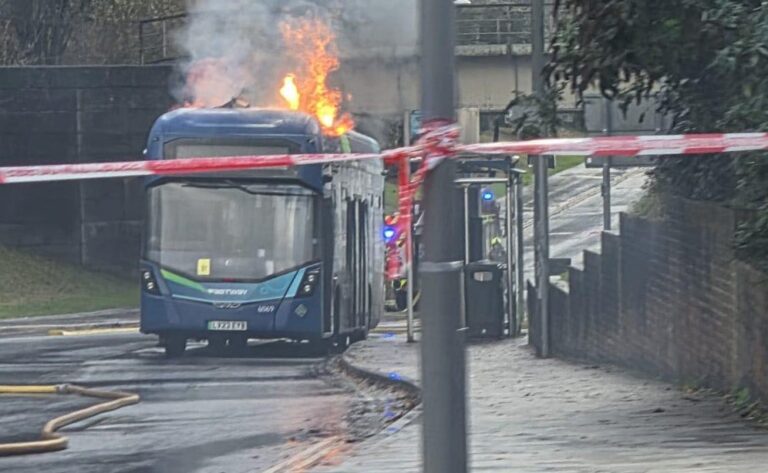
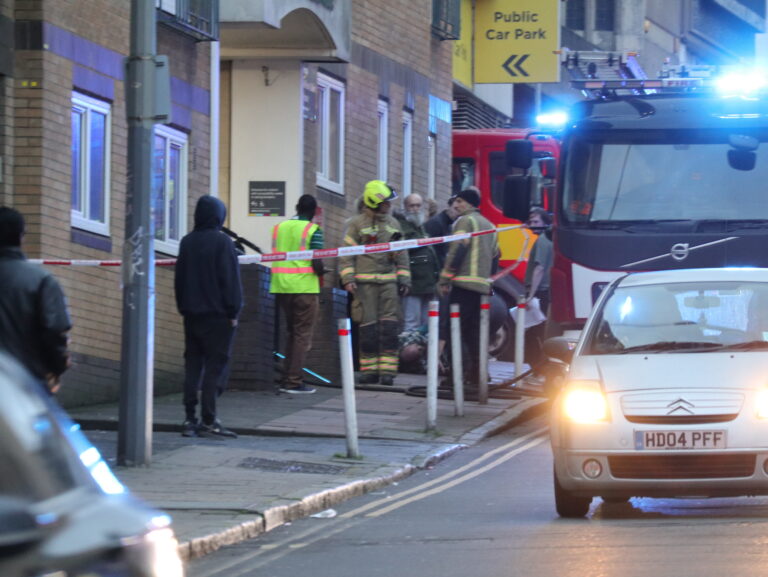
Emergency services rushed to Crawley town centre this afternoon after a hydrogen-powered bus caught fire near one of the area’s busiest shopping destinations.
West Sussex Fire and Rescue Service confirmed they were called at 12.36pm to reports of a bus alight on Southgate Avenue, close to the County Mall shopping centre.
The vehicle involved is believed to be one of Metrobus’ zero-emission hydrogen buses, part of the operator’s environmentally friendly fleet. Metrobus has been approached for comment.
A fire service spokeswoman said:
“Joint Fire Control mobilised three fire engines and an aerial ladder platform to the scene. Upon arrival crews found a fire on a bus. Firefighters wearing breathing apparatus are working to extinguish the fire. People are being advised to avoid the area.”
Firefighters have since brought the blaze under control, and the incident is now over. No injuries have been reported.
The fire caused disruption in the town centre earlier this afternoon, with members of the public advised to avoid Southgate Avenue while emergency crews worked at the scene.





6 Comments
My friend and I saw the closed of roads to the town then realised it was a Hydrogen H02 Electric bus yesterday
Hydrogen.. the next “green” scam. It takes twice as much energy to produce than it provides. It needs to be compressed and cooled to -253ºC for transport, which takes MORE energy. There are HUGE problems with transport and storage, being the simplest element (1 proton, 1 neutron, 1 electron) it is also the smallest, so will easily leak past any seal or threaded joint and react with any material used to contain it. (see ‘hydrogen embrittlement below’) It burns with an invisible flame in daylight. And perhaps the greatest problem, energy density. It takes about a dozen tankers of liquid hydrogen to provide the same amount of energy as one tanker of petrol. Hydrogen is totally impractical, ridiculously expensive and highly dangerous.
Hydrogen embrittlement is a process where absorbed atomic hydrogen enters a metal, reducing its ductility and load-bearing capacity, leading to cracking and premature failure. It primarily affects high-strength steels and other alloys, forming under specific conditions of hydrogen presence, high strength, and applied or residual stress. The absorbed hydrogen can cause internal stress concentrations, weakening the metal’s structure.
How it Works
Hydrogen Absorption:
Atomic hydrogen, being very small, can diffuse and penetrate into the metal’s microstructure.
Accumulation:
Hydrogen atoms accumulate in energetically favourable sites like grain boundaries, inclusions, and areas of high tensile stress.
Microstructural Weakening:
The presence of hydrogen can interfere with the metal’s normal plastic deformation process, leading to localized regions of stress and microstructural sites.
Crack Formation:
This accumulation of hydrogen and resulting stress can cause tiny cracks to form and grow, leading to sudden, catastrophic failure.
Great comment! Correct in every respect. I would add the flammability range of hydrogen is a big problem. Hydrogen will burn if its concentration in air is between 4% to 75%. Gasoline will burn only if its concentration is between 1.4% to 7.6%. Thus, just about any leak of hydrogen gas can burn unlike gasoline leaks.
I would stick to fossil fuels in future
Hydrogen has no neutron. That is why it’s so reactive and wanting to combine with other elements
And yet hydrogen was supplied to every home in the UK for over a century without any of the problems mentioned. Only when it was replaced with natural gas did problems emerge and a nationwide replacement of pipes required!